

• Submit Poetry
  • About Us
  • Members
  • Support SCP
Thursday, September 25, 2025
Society of Classical Poets
  • Poems
    • Beauty
    • Culture
    • Satire
    • Art
    • Children’s Poetry
    • Covid-19
    • Ekphrastic
    • Epic
    • Epigrams and Proverbs
    • Found Poems
    • Human Rights in China
    • Humor
    • Music
    • Performing Arts
    • Riddles
    • Science
    • Song Lyrics
    • Terrorism
    • The Environment
    • The Raven
  • Poetry Forms
    • Acrostic
    • Alexandroid
    • Alliterative
    • Blank Verse
    • Chant Royal
    • Clerihew
    • Haiku
    • Limerick
    • Pantoum
    • Rhupunt
    • Rondeau Redoublé
    • Rondeau
    • Rondel
    • Rubaiyat
    • Sapphic Verse
    • Sestina
    • Shape Poems
    • Sonnet
    • Terza Rima
    • Triolet
    • Villanelle
  • Great Poets
    • Dante Alighieri
    • Edgar Allan Poe
    • Emily Dickinson
    • Geoffrey Chaucer
    • Henry Wadsworth Longfellow
    • Homer
    • John Keats
    • John Milton
    • Robert Frost
    • William Blake
    • William Shakespeare
    • William Wordsworth
  • Love Poems
  • Contests
  • SCP Academy
    • Educational
    • Teaching Classical Poetry—A Guide for Educators
    • Poetry Forms
    • The SCP Journal
    • Books
No Result
View All Result
Society of Classical Poets
  • Poems
    • Beauty
    • Culture
    • Satire
    • Art
    • Children’s Poetry
    • Covid-19
    • Ekphrastic
    • Epic
    • Epigrams and Proverbs
    • Found Poems
    • Human Rights in China
    • Humor
    • Music
    • Performing Arts
    • Riddles
    • Science
    • Song Lyrics
    • Terrorism
    • The Environment
    • The Raven
  • Poetry Forms
    • Acrostic
    • Alexandroid
    • Alliterative
    • Blank Verse
    • Chant Royal
    • Clerihew
    • Haiku
    • Limerick
    • Pantoum
    • Rhupunt
    • Rondeau Redoublé
    • Rondeau
    • Rondel
    • Rubaiyat
    • Sapphic Verse
    • Sestina
    • Shape Poems
    • Sonnet
    • Terza Rima
    • Triolet
    • Villanelle
  • Great Poets
    • Dante Alighieri
    • Edgar Allan Poe
    • Emily Dickinson
    • Geoffrey Chaucer
    • Henry Wadsworth Longfellow
    • Homer
    • John Keats
    • John Milton
    • Robert Frost
    • William Blake
    • William Shakespeare
    • William Wordsworth
  • Love Poems
  • Contests
  • SCP Academy
    • Educational
    • Teaching Classical Poetry—A Guide for Educators
    • Poetry Forms
    • The SCP Journal
    • Books
No Result
View All Result
Society of Classical Poets
No Result
View All Result
Home Poetry Beauty

A Poem on Two Dragon Statues in Vietnam, by G.M.H. Thompson

September 28, 2023
in Beauty, Ekphrastic, Poetry
A A
8
poem/thompson/ekphrastic

.

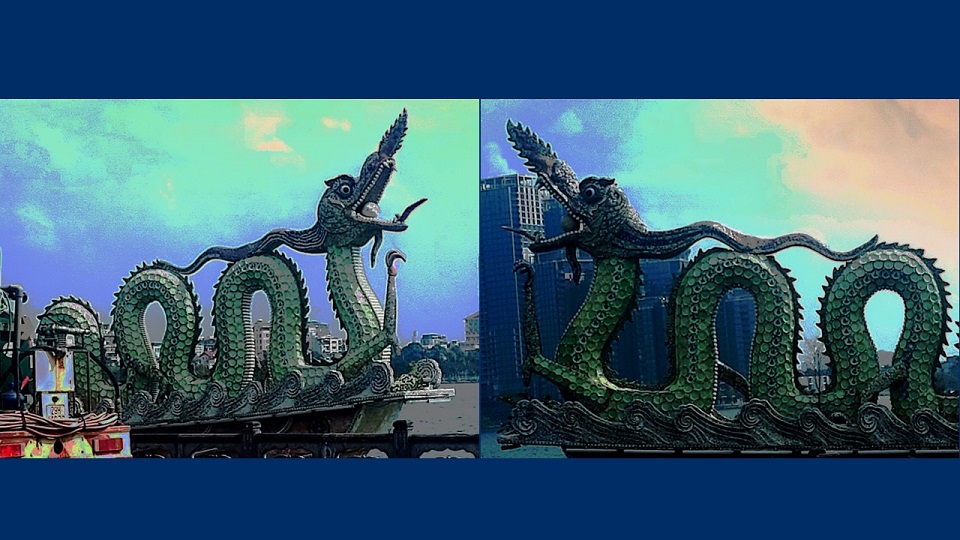
Two Dragon Statues

Tây Hồ, Hà Nội, Việt Nam, Constructed 2012

They stand on waves just off West Lake’s west bank—
two dragon statues—jade ceramic gods
commemorating when the Emperor
beheld a soaring dragon, Heaven’s sign
that Thăng Long should be made the capital,
which doomed Hoa Lư, the ancient royal seat,
to be forgot, with only fields of rice
& limestone peaks its mausoleums now,
whereas Hà Nội’s metropolis endures
& thrives, a booming heart of industry
& art that more than eight million call home.
At night Hà Nội’s young couples gather here—
the pearls these basilisks enshrine with teeth
perhaps are thought to consecrate true love.

RELATED

‘When Helen Keller Met Mark Twain’: A Poem by Brian Yapko

‘When Helen Keller Met Mark Twain’: A Poem by Brian Yapko

September 21, 2025
Five Rose Poems by Rainer Maria Rilke, Translated by Alan Orsborn

‘Roses Are Red’: A Poem by Evan Tester

September 10, 2025

.

.

G.M.H. Thompson spent the last year teaching in Ha Noi, Viet Nam. He recently put out a book of illustrated sonnets entitled Quetzalcoatl, available through on Amazon.

ShareTweetShare
The Society of Classical Poets does not endorse any views expressed in individual poems or commentary.
Read Our Comments Policy Here
Next Post
poetry/coats/haiku and senryu

The 23 Best Haiku of 2023

poem/erlandson/lost child

'Ode to the Strings of My Guitar': A Poem by Daniel Howard

‘Wood’: A Poem by Mary Kipps

'Wood': A Poem by Mary Kipps

Comments 8

  1. Phil L Flott says:
    2 years ago

    Excellent Iambic Pentameter.

    Reply
    • G.M.H. Thompson says:
      2 years ago

      Oh, thank you. I’ve been reading a lot of the epics lately, so my pen’s in pretty fine form.

      Reply
  2. Paul Freeman says:
    2 years ago

    A tale told so concisely, and I loved the end.

    Thanks for the read.

    Reply
    • G.M.H. Thompson says:
      2 years ago

      Thank you & I’m glad you liked it.

      Reply
  3. Susan Jarvis Bryant says:
    2 years ago

    A most intriguing piece that paints a vivid picture of the ‘Two Dragon Statues’. I particularly like the closing three lines… a touch of romance and mystique to mull upon.

    Reply
    • G.M.H. Thompson says:
      2 years ago

      Originally, that tercet read:

      At night, the lovers come to kiss beneath
      these civic saints– the pearl each gaping jaw
      contains perhaps suggests fertility.

      I think the editor thought this was too risqué or something, so he asked me to change it to what it is now. I still think how I had it at first was better, but you know, it’s whatever, I change them to be how editors like– it still gets the point across. I just wanted to go for more of Stravinsky Rite of Spring sort of feel, you know?

      Reply
  4. BDW says:
    2 years ago

    It’s nice to hear your voice again. I am sorry I got to responding so slowly, but as I write a weekly column of poetry, no week goes by when I am not besieged by time. I would not have it any other way, yet I am sorry for this long delay. Although I’m fighting iambic pentameter generally, I understand why one would use blank verse in attemting to write an epic; since none have outdone Milton in their attempts. Still, all the many epics since his time, show that the genre still has not been scaled with his amazing power. I think all of us, at least from Wordsworth on, have faced it in our own ways, and that variety amazes in and of itself.

    In “Two Dragon Statuues” I did find the placement of the word “million” awkward, but perhaps no more than most of Milton’s “Paradise Lost”. However, I did like the diction of your “sonnet”; perhaps it will help you to achieve what you desire in your future writing.

    Reply
    • G.M.H. Thompson says:
      2 years ago

      Well, one of the problems with rhymes in English is they decay so fast. The language has changed at least twice since Chaucer, so a lot of his rhymes didn’t rhyme by Shakespeare’s day, 200 years later, and nowadays, many of Shakespeare’s rhymes don’t rhymes. The metre still holds mostly, although some words lost a syllable here & there. Another problem with rhyming in English is that some ending sounds only have one or two words that actually work. If you read the collected works of Sylvia Plath, you can notice that she actually uses slant rhyme in almost all of her poems (all, almost all of her poems are syllabics, i.e. with a set number of syllables per line), a very innovative way around this problem that additionally avoids another problem of rhyming, namely that rhymed poems often can sound sing-songy and the ending words often sound overly determined by the fact that they have to rhyme, and whether this is true or not, it undermines the effectiveness of those end words.

      Reply

Leave a Reply Cancel reply

Your email address will not be published. Required fields are marked *

Discussions

  • Garima Obrah on The Society of Classical Poets 2025 Haiku Competition
  • Prashant Rawal on The Society of Classical Poets 2025 Haiku Competition
  • Michael Vanyukov on ‘Dear Blabby’s Advice for the Clueless’: A Poem by Roy E. Peterson
  • Michael Vanyukov on ‘Absalom, Absalom’: A Poem by Brian Yapko
  • Sreeja Mohandas on The Society of Classical Poets 2025 Haiku Competition
  • Amie on The Society of Classical Poets 2025 Haiku Competition
  • Katherine Davies on The Society of Classical Poets 2025 Haiku Competition
  • Leslie Hendrickson-Baral on The Society of Classical Poets 2025 Haiku Competition
  • Paulette Calasibetta on ‘Absalom, Absalom’: A Poem by Brian Yapko
  • Joseph S. Salemi on ‘Absalom, Absalom’: A Poem by Brian Yapko
  • Prae Pathanasethpong on The Society of Classical Poets 2025 Haiku Competition
  • Venessa Lee-Estevez on The Society of Classical Poets 2025 Haiku Competition
Facebook Twitter Youtube

Archive

Categories

Quick Links

  • Submit Poetry
  • About Us
  • Become a Member
  • Members List
  • Support the Society
  • Advertisement Placement
  • Comments Policy
  • Privacy Policy
  • Terms of Use

Welcome Back!

Sign In with Facebook
Sign In with Google
OR

Login to your account below

Forgotten Password? Sign Up

Create New Account!

Sign Up with Facebook
Sign Up with Google
OR

Fill the forms below to register

All fields are required. Log In

Retrieve your password

Please enter your username or email address to reset your password.

Log In
No Result
View All Result
  • Poems
    • Beauty
    • Culture
    • Satire
    • Art
    • Children’s Poetry
    • Covid-19
    • Ekphrastic
    • Epic
    • Epigrams and Proverbs
    • Found Poems
    • Human Rights in China
    • Humor
    • Music
    • Performing Arts
    • Riddles
    • Science
    • Song Lyrics
    • Terrorism
    • The Environment
    • The Raven
  • Poetry Forms
    • Acrostic
    • Alexandroid
    • Alliterative
    • Blank Verse
    • Chant Royal
    • Clerihew
    • Haiku
    • Limerick
    • Pantoum
    • Rhupunt
    • Rondeau Redoublé
    • Rondeau
    • Rondel
    • Rubaiyat
    • Sapphic Verse
    • Sestina
    • Shape Poems
    • Sonnet
    • Terza Rima
    • Triolet
    • Villanelle
  • Great Poets
    • Dante Alighieri
    • Edgar Allan Poe
    • Emily Dickinson
    • Geoffrey Chaucer
    • Henry Wadsworth Longfellow
    • Homer
    • John Keats
    • John Milton
    • Robert Frost
    • William Blake
    • William Shakespeare
    • William Wordsworth
  • Love Poems
  • Contests
  • SCP Academy
    • Educational
    • Teaching Classical Poetry—A Guide for Educators
    • Poetry Forms
    • The SCP Journal
    • Books

© 2025 SCP. WebDesign by CODEC Prime.

This website uses cookies. By continuing to use this website you are giving consent to cookies being used. Visit our Privacy and Cookie Policy.