

.
Absalom, Absalom
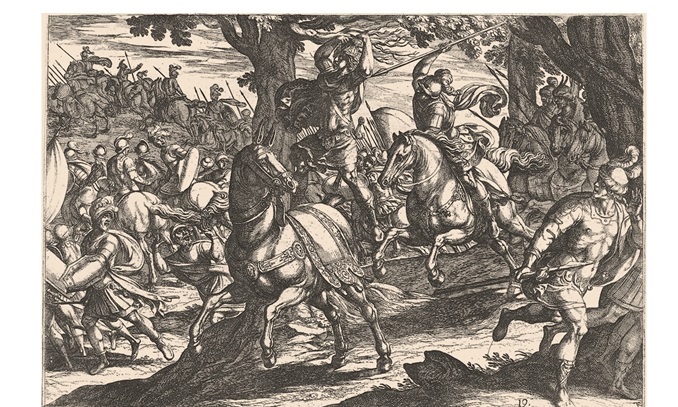
“Then David sent out [to battle Absalom’s army] one third of the people… And the king said to the people, ‘I also will surely go out with you myself.’ But the people answered, ‘You shall not go out! … You are worth ten thousand of us now. For you are now more help to us in the city.’ Then the king said to them, ‘Whatever seems best to you I will do.’ So the king stood beside the gate, and all the people went out by hundreds and by thousands. Now the king had commanded [the captains], ‘Deal gently for my sake with the young man Absalom.’ And all the people heard when the king gave all the captains orders concerning Absalom.“ —2 Samuel 18:2-5
How well I can recall when you were nine
And burned with fever. None thought you’d survive.
I wept. I prayed. I begged God for a sign
That you, my treasured son, might stay alive.
I kneeled before you, murmured lullabies;
And Heaven heard my sobbing and my sighs.

The decades passed. The son I cherished most
Defamed me, tried to stab me in the back,
Usurp my throne and kill my loyal host.
O, Absalom. Survive this day’s attack!
The loss you need to taste is justly earned
As payment for the father’s love you’ve spurned.
I’m glad I’m banned as witness to this fight.
I am instead directed to wait here
Beside this gate. The Lord expects my spite
To fade and wither ere you are brought near.
Soon smoke will rise to show the battle’s done—
We’ll then meet face-to-face, my faithless son.
O, Traitor! Absalom! Yet I would know
That in defeat you’re safe. You shall return
In chains to face your king. I’ll mete out woe
For you have painful lessons yet to learn.
You did far worse than mock and criticize
My governance! To wound me was unwise.
But soon enough I’ll have my son again!
Poor Absalom! You were deceived and driven
By him who tempted Eve and lied to Cain.
Just show repentance—you will be forgiven!
Like you, I’ve made grave errors I must face;
But even so, God’s showered me with grace.
I know when you were younger you meant well:
Your brother forced his flesh upon your sister.
A rape, you screamed. A knife. Then Amnon fell
By your own hand. Such evil days! A Twister—
Like God wrought unto Job—whirled forth to smash
Our dynasty, to grind hope into ash.
Our royal house has faced such painful days!
Tamar, then Amnon—tragedies I’ve pondered
So deeply they seem twisted like a maze.
And then you left. You left me and you wandered.
You changed. You mocked me as a king and father.
You would not hear my side. You could not bother.
But brute sedition? Give me one good reason!
You were my pride—a son both smart and able.
You had no right to stumble into treason
Or call my life a failed and tortured fable.
You warped the truth to overthrow my State.
How readily can love morph into hate!
I love you with a hate which rends my heart.
O, Absalom, I injured you and failed
To guide you well. But, son, can we not start
Anew once you’ve been chained and I’ve prevailed?
God hears my prayers. He will not turn His face.
He’ll surely lead you back to my embrace.
How many of my enemies have said
“The King hath no deliverance in God!”
But they are wrong! The Lord anoints my head,
And blessings line the road that I have trod!
The hatred we have felt can be reversed.
Let’s both forget that we each other cursed!
My Absalom! God feels our hurt and pain,
And surely He won’t let us suffer more.
His grace shall wash our sins away like rain
And we shall love each other as before.
The hate that poisons love at last shall cease.
Jerusalem shall be a place of peace.
.
.
Brian Yapko is a retired lawyer whose poetry has appeared in over fifty journals. He is the winner of the 2023 SCP International Poetry Competition. Brian is also the author of several short stories, the science fiction novel El Nuevo Mundo and the gothic archaeological novel Bleeding Stone. He lives in Wimauma, Florida.
Beautiful poem. Delightfully reminiscent of Melville’s “Clarel.” Metre is a bit questionable on certain lines, such as “I wept. I prayed. I begged God for a sign” from the first stanza, where the impulse is on ‘begged’ and ‘God’ is lowered — a bit unnatural by my reading (not to mention arguably blasphemous — I joke). Lovely poem on the whole though.
Another great poem, this time on the conflict too often between a father and a son. Ripped from the scripture of the “Bible” these amazing words of the love/hate relationship are amplified and treated with great masterful sensitivity for the father’s grief and pain. I once recently intimated you were a rising star in the field of classical poetry. With your most recent poems you are already shining there in the constellation.
A concisely conveyed and depressingly common Sunday-morning-story, Brian. I’m reminded of the countless roller-coaster relationships between heart broken parents, that never quit wishing it weren’t so, and their strays, praying that, someday, they’ll manage, to some degree at least – reconcile. A wonderfully meaningful piece. 🙂
A great story and pleasing that you left the punch line out – capturing all the hope for a lost son, and none of the final hell and its finality.
This is a very fine dramatic monologue on a scriptural story. It inevitably calls up memories of Dryden’s “Absalom and Achitophel” and Faulkner’s
“Absalom! Absalom!” Brian’s poem is of course a concise one of eleven stanzas, and is for that reason tightly focused — that is, we get the viewpoints and emotional reactions of King David, and only hear those of others second-hand, from David’s words. But that is part of the structure of a dramatic monologue — it must present us with the interior world of the speaker primarily, especially when it is a soliloquy such as this poem is, with no silent interlocutor.
I don’t see anything questionable about the meter. In fact it is severely regular, with only a few substitutions here and there, of the normal and traditional type in iambic pentameter.
The tale is about an archetypal problem in parent-child relationships. The hormonally and psychologically programmed rivalry of father and son will come out in some manner, but the natural ties of affection will always remain as a complicating factor. The Hebrew story, by placing that archetypal conflict in the context of an intense political situation, turns the matter into a nation-shaking catastrophe.
This is another triumph by Brian Yapko.
A beautifully crafted poem, created from a biblical passage that universally resonates in the complicated relationship between father and son; of love and loss.
Just a small fragment of the complex story of Avshalom (Absalom), who “stole the hearts of the men of Israel,” so masterfully retold. Especially poignant is the cliffhanger of David’s hope for reconciliation (and the unnamed reasons for it despite the rebellion), which we know would not happen.