• Submit Poetry
  • About Us
  • Members
  • Support SCP
Thursday, December 18, 2025
Society of Classical Poets
  • Poems
    • Beauty
    • Culture
    • Satire
    • Art
    • Children’s Poetry
    • Covid-19
    • Ekphrastic
    • Epic
    • Epigrams and Proverbs
    • Found Poems
    • Human Rights in China
    • Humor
    • Music
    • Performing Arts
    • Riddles
    • Science
    • Song Lyrics
    • Terrorism
    • The Environment
    • The Raven
  • Poetry Forms
    • Acrostic
    • Alexandroid
    • Alliterative
    • Blank Verse
    • Chant Royal
    • Clerihew
    • Haiku
    • Limerick
    • Pantoum
    • Rhupunt
    • Rondeau Redoublé
    • Rondeau
    • Rondel
    • Rubaiyat
    • Sapphic Verse
    • Sestina
    • Shape Poems
    • Sonnet
    • Terza Rima
    • Triolet
    • Villanelle
  • Great Poets
    • Dante Alighieri
    • Edgar Allan Poe
    • Emily Dickinson
    • Geoffrey Chaucer
    • Henry Wadsworth Longfellow
    • Homer
    • John Keats
    • John Milton
    • Robert Frost
    • William Blake
    • William Shakespeare
    • William Wordsworth
  • Love Poems
  • Contests
  • SCP Academy
    • Educational
    • Teaching Classical Poetry—A Guide for Educators
    • Poetry Forms
    • The SCP Journal
    • Books
No Result
View All Result
Society of Classical Poets
  • Poems
    • Beauty
    • Culture
    • Satire
    • Art
    • Children’s Poetry
    • Covid-19
    • Ekphrastic
    • Epic
    • Epigrams and Proverbs
    • Found Poems
    • Human Rights in China
    • Humor
    • Music
    • Performing Arts
    • Riddles
    • Science
    • Song Lyrics
    • Terrorism
    • The Environment
    • The Raven
  • Poetry Forms
    • Acrostic
    • Alexandroid
    • Alliterative
    • Blank Verse
    • Chant Royal
    • Clerihew
    • Haiku
    • Limerick
    • Pantoum
    • Rhupunt
    • Rondeau Redoublé
    • Rondeau
    • Rondel
    • Rubaiyat
    • Sapphic Verse
    • Sestina
    • Shape Poems
    • Sonnet
    • Terza Rima
    • Triolet
    • Villanelle
  • Great Poets
    • Dante Alighieri
    • Edgar Allan Poe
    • Emily Dickinson
    • Geoffrey Chaucer
    • Henry Wadsworth Longfellow
    • Homer
    • John Keats
    • John Milton
    • Robert Frost
    • William Blake
    • William Shakespeare
    • William Wordsworth
  • Love Poems
  • Contests
  • SCP Academy
    • Educational
    • Teaching Classical Poetry—A Guide for Educators
    • Poetry Forms
    • The SCP Journal
    • Books
No Result
View All Result
Society of Classical Poets
No Result
View All Result
Home Poetry Beauty

Verses from the Irish Peace Park

October 2, 2020
in Beauty, Culture, Found Poems, Poetry
A A
8
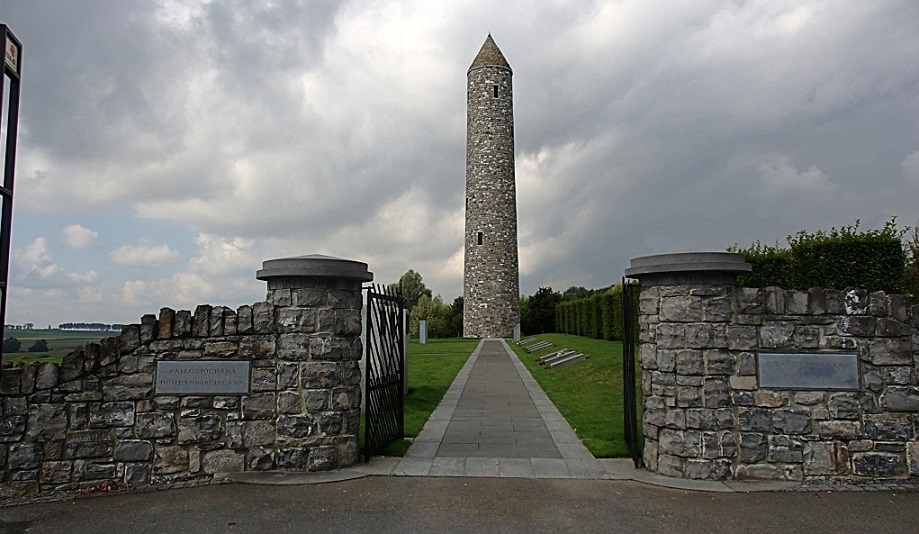
OLYMPUS DIGITAL CAMERA

OLYMPUS DIGITAL CAMERA

In the first World War, taking and holding the high ground was everything. The battle of Messines Ridge, in Belgium, took place June 7-17 1917. It took 81 years until the Irish Peace Park was unveiled there to acknowledge the sacrifice of combatants from the whole island of Ireland during the War, particularly the Irish 16th and the Ulster 36th Divisions. Casualties were a staggering 28,398 and 32,186 respectively. The unveiling was the first time that an Irish head of state had ever met a British Monarch. The highly complex political and religious divide was forgotten for a day as the Irish president, Mary McAleese, apologised for the years of “national amnesia.”

The soldiers at Messines Ridge fought bravely together and took all their objectives. These three verses are part of a series of 11 stone tablets at the park entrance and are a moving testament to the ordinary soldiers caught up in the conflict.

—Jeff Eardley

RELATED

‘When Helen Keller Met Mark Twain’: A Poem by Brian Yapko

‘When Helen Keller Met Mark Twain’: A Poem by Brian Yapko

September 21, 2025
Five Rose Poems by Rainer Maria Rilke, Translated by Alan Orsborn

‘Roses Are Red’: A Poem by Evan Tester

September 10, 2025


So here, while the mad guns curse overhead,
and tired men sigh, with mud for couch and floor,
know that we fools, now with the foolish dead,
died not for Flag, nor King, nor Emperor,
but for a dream born in a herdsman’s shed,
and for the sacred scripture of the poor.

—Tom Kettle, 9th Dublin Fusiliers


It is too late now to retrieve a fallen dream,
too late to grieve a name unmade,
but not too late to thank the Gods for what is great.
A keen-edged sword, a soldier’s heart is greater than a poet’s art.
And greater than a poet’s fame, a little grave that has no name.

—Francis Ledwidge, 5th Inniskilling Fusiliers


I wish the sea were not so wide
that parts me from my love.
I wish that things men do below
were known to God above.
I wish that I were back again
in the Glens of Donegal.
They’ll call me coward if I return
but a hero if I fall.

—Patrick MacGill, London Irish Rifles


Jeff Eardley lives in the heart of England near to the Peak District National Park and is a local musician playing guitar, mandolin and piano steeped in the music of America, including the likes of Ry Cooder, Paul Simon and particularly Hank Williams.

ShareTweetShare
The Society of Classical Poets does not endorse any views expressed in individual poems or commentary.
Read Our Comments Policy Here
Next Post
A Poem on Riots Across America: ‘Ethics Lesson 101,’ and Others by Bruce Dale Wise

A Poem on Riots Across America: 'Ethics Lesson 101,' and Others by Bruce Dale Wise

‘Spindle, Shuttle, Loom’ by Joseph S. Salemi

'Spindle, Shuttle, Loom' by Joseph S. Salemi

‘A Sonnet?’ by Carly Britt

'Sonnet Sonnet' by Theresa Rodriguez

Comments 8

  1. Mike Bryant says:
    5 years ago

    These men and so many more have bought us the freedom we now enjoy. Our enemies have never been more powerful. We are in for the fight of our lives against authoritarianism.
    Of the three my favorite is the last. It seems to sum up everything quite beautifully.

    Reply
    • Jeff Eardley says:
      5 years ago

      Mike, thanks for that. The final couplet of the third poem hit me straight in the heart when I first read it at the Peace Park. My grandmother’s first husband was killed near to here. He was a 37 year old miner who was there to burrow under the German lines in order to lay enormous mines. I cannot imagine the horror of that. It looks like you have a few battles to come, with yet another breaking out today.

      Reply
  2. Margaret Coats says:
    5 years ago

    Thanks for the great selection, Jeff. Mike has certainly chosen the simplest and most profound, but my favorite is the first, by Tom Kettle. He defines a startling juxtaposition of madness of the great and foolishness of the least in his first three lines. And he ends by pointing effectively to the sacredness of the dreams of those who were least.

    As an inveterate editor, I’ll suggest what I think is better punctuation for the second poem. I realize it may read exactly as it appears in the park, but if the “keen-edged sword” is the soldier’s heart, it would be great to set off “a soldier’s heart” with m dashes. And there should be a comma rather than a period at the end of that line, as the two lines form a compound sentence.

    Reply
  3. Jeff Eardley says:
    5 years ago

    Margaret, thank you for your comments and as ever, your meticulous attention to punctuation. I am always moved by War poetry, particularly coming from the dreadful carnage of World War I, but to gaze out over the repaired landscape in this part of Flanders lends a poignancy to the words of these young men.

    Reply
  4. Rod Walford says:
    5 years ago

    These are truly heartfelt and poignant poems Jeff – thank you for sharing them. I would have to say the last poem with its final couplet brought a lump to my throat with its sad and basic truth. I hope that Patrick now finds great solace in that the wish he expresses in his second couplet has been granted.

    Reply
  5. Jeff Eardley says:
    5 years ago

    Thanks Rod, yes the final couplet says so much in so few words. Whenever I read this type of verse I am always saddened that so much eloquence was extinguished in that dreadful conflict.

    Reply
  6. Susan Jarvis Bryant says:
    5 years ago

    Jeff, thank you very much for providing us with the opportunity to read these heartfelt stone tablet verses inspired by a war that should never be forgotten. While my heart aches with the sentiments of the third poem, the first poem gives a real sense of the horrors of WWI – “mad guns curse overhead” and “mud for couch and floor” are raw depictions of unimaginable conditions these soldiers endured.

    If anyone is interested in WWI, I thoroughly recommend Peter Jackson’s “They Shall Not Grow Old”. The film was created using original footage (previously unseen and all over 100 years old) from the Imperial War Museum’s archives. They used computer technology to add colour, correct the speed, and add dialogue. They used lip readers to interpret the original footage, and then hired speakers from the regions the soldiers came from to add authenticity. It brings an up-to-date immediacy to the savagery of war, and will leave many with a greater understanding of the sacrifices made.

    To think that WWI and WWII were fought in the name of freedom… a freedom many do not respect and are willing and ready to give away. Thanks again for the reminder.

    Reply
  7. Jeff Eardley says:
    5 years ago

    Susan, thank you so much for your comments. We have travelled extensively around Europe where the horrors of war are never far away, particularly Verdun where millions of French and Germans died for nothing.
    The place that always moves us to tears is the American war cemetery at Omaha beach where so many of your countrymen paid such a heavy price.
    We have watched “They Shall Not Grow Old” so many times. It is a work of genius. I can also recommend the film “War Horse”
    Thanks again and look forward to your next offering and good luck with your election. You are going to need it now, and if all fails, you can have Harry and Meghan instead.

    Reply

Leave a Reply to Margaret Coats Cancel reply

Your email address will not be published. Required fields are marked *

Discussions

  • Garima Obrah on The Society of Classical Poets 2025 Haiku Competition
  • Prashant Rawal on The Society of Classical Poets 2025 Haiku Competition
  • Michael Vanyukov on ‘Dear Blabby’s Advice for the Clueless’: A Poem by Roy E. Peterson
  • Michael Vanyukov on ‘Absalom, Absalom’: A Poem by Brian Yapko
  • Sreeja Mohandas on The Society of Classical Poets 2025 Haiku Competition
  • Amie on The Society of Classical Poets 2025 Haiku Competition
  • Katherine Davies on The Society of Classical Poets 2025 Haiku Competition
  • Leslie Hendrickson-Baral on The Society of Classical Poets 2025 Haiku Competition
  • Paulette Calasibetta on ‘Absalom, Absalom’: A Poem by Brian Yapko
  • Joseph S. Salemi on ‘Absalom, Absalom’: A Poem by Brian Yapko
  • Prae Pathanasethpong on The Society of Classical Poets 2025 Haiku Competition
  • Venessa Lee-Estevez on The Society of Classical Poets 2025 Haiku Competition
Facebook Twitter Youtube

Archive

Categories

Quick Links

  • Submit Poetry
  • About Us
  • Become a Member
  • Members List
  • Support the Society
  • Advertisement Placement
  • Comments Policy
  • Privacy Policy
  • Terms of Use

Welcome Back!

Sign In with Facebook
Sign In with Google
OR

Login to your account below

Forgotten Password? Sign Up

Create New Account!

Sign Up with Facebook
Sign Up with Google
OR

Fill the forms below to register

All fields are required. Log In

Retrieve your password

Please enter your username or email address to reset your password.

Log In
No Result
View All Result
  • Poems
    • Beauty
    • Culture
    • Satire
    • Art
    • Children’s Poetry
    • Covid-19
    • Ekphrastic
    • Epic
    • Epigrams and Proverbs
    • Found Poems
    • Human Rights in China
    • Humor
    • Music
    • Performing Arts
    • Riddles
    • Science
    • Song Lyrics
    • Terrorism
    • The Environment
    • The Raven
  • Poetry Forms
    • Acrostic
    • Alexandroid
    • Alliterative
    • Blank Verse
    • Chant Royal
    • Clerihew
    • Haiku
    • Limerick
    • Pantoum
    • Rhupunt
    • Rondeau Redoublé
    • Rondeau
    • Rondel
    • Rubaiyat
    • Sapphic Verse
    • Sestina
    • Shape Poems
    • Sonnet
    • Terza Rima
    • Triolet
    • Villanelle
  • Great Poets
    • Dante Alighieri
    • Edgar Allan Poe
    • Emily Dickinson
    • Geoffrey Chaucer
    • Henry Wadsworth Longfellow
    • Homer
    • John Keats
    • John Milton
    • Robert Frost
    • William Blake
    • William Shakespeare
    • William Wordsworth
  • Love Poems
  • Contests
  • SCP Academy
    • Educational
    • Teaching Classical Poetry—A Guide for Educators
    • Poetry Forms
    • The SCP Journal
    • Books

© 2025 SCP. WebDesign by CODEC Prime.

This website uses cookies. By continuing to use this website you are giving consent to cookies being used. Visit our Privacy and Cookie Policy.